The 2026 Icelandic Eiderdown Report
A rare natural material

Every spring, eider farmers along Iceland’s coastline prepare nesting grounds for the return of wild eider ducks. They clear
and maintain the nesting areas and help protect the birds from predators and unnecessary disturbance. The ducks are wild
and return of their own accord. During nesting, each female lines her nest with soft down from her breast, helping to keep her
eggs warm. When it is safe to collect the down, it is gathered carefully by hand. It then goes through a demanding cleaning
process before it can be used in bedding. This relationship between the birds and Iceland's eider farmers has developed over
centuries and is central to the way eiderdown is produced today.
Source: Icelandic Eider Farmers Association
At Icelandic Down, we believe the rarity and value of this natural material can be better understood through facts.
This report looks at how much eiderdown Iceland produces, how much is exported as raw material, and how exports of
finished eiderdown bedding have developed in recent years. We use official customs statistics alongside Icelandic Down’s
own records and identify the sources separately.
Icelandic eiderdown in numbers
Approximately 3,000 kg annually
Iceland produces an estimated 3,000 kg of cleaned eiderdown in a typical year, although the amount varies with each nesting
season. Estimated worldwide production is only around 4,000–5,000 kg annually. These are industry estimates, not complete
annual production counts.
Source: Icelandic Eider Farmers Association. The Common Eider Sea Duck Contributes to Its Own Conservation by Donating Its Feathers
Around 380 eider farmers
A historical estimate reported in 2022.
Source: Bændablaðið (2022)
Around 15–20 g per nest
An approximate cleaned yield, equivalent to roughly 60 nests per kilogram.
Source: RÚV (2025)
Raw eiderdown exports
As the graph shows, export volumes vary considerably from year to year. However, exports are not the same as the annual
harvest. Eiderdown may be stored, used in Iceland or exported in a later year.
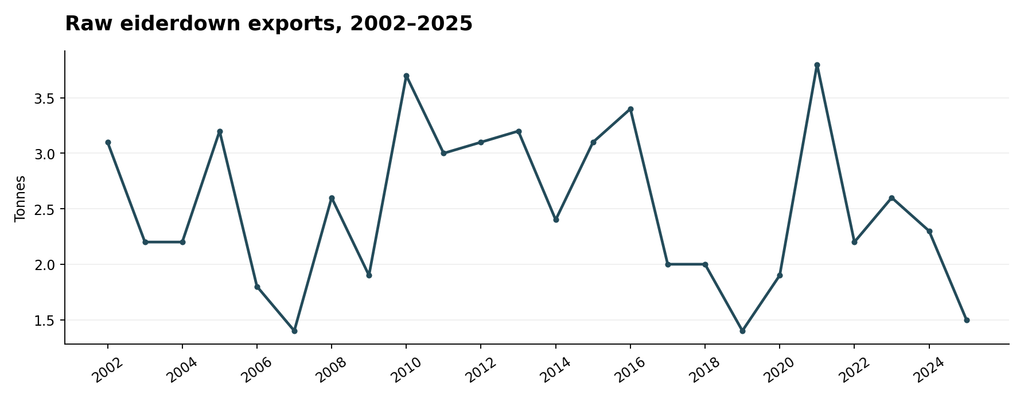
Raw eiderdown exports, 2002–2025. Tonnes.
Recorded exports were 1.5 tonnes in 2025, compared with 2.3 tonnes in 2024. For January–June 2026, the figure was 0.6 tonnes. This is a half-year figure and should not be compared directly with full years.
Source: Statistics Iceland, exports by tariff code, historical series 2002–2025,
The changing export value of eiderdown
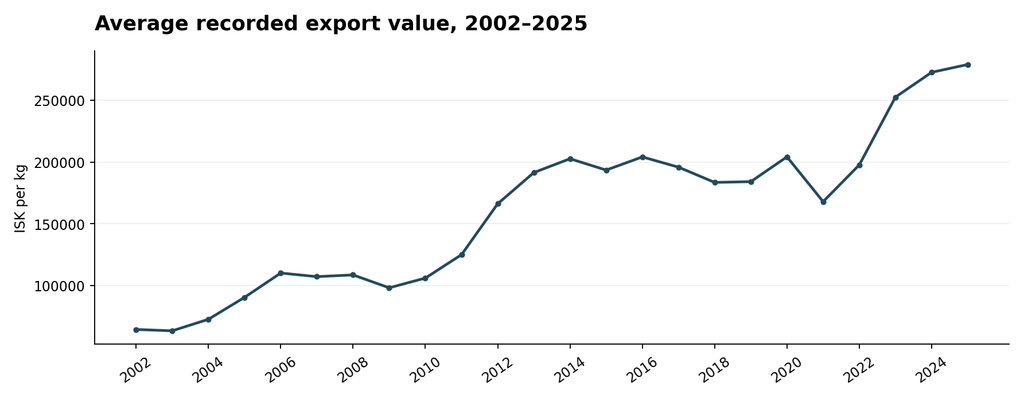
Average FOB export value per kilogram, nominal ISK, not inflation-adjusted.
The average recorded export value rose from approximately ISK 64,000 per kilogram in 2002 to ISK 279,000 in 2025. These are FOB export values, not the prices farmers receive. For comparison, Icelandic Down paid farmers approximately ISK 270,000 per kilogram, excluding VAT, in 2025.
Source: Source: Statistics Iceland, exports by tariff code, historical series 2002–2025
For January–June 2026, the average recorded export value was approximately ISK 230,000 per kilogram. It is too early to say whether this points to a lasting decline. Shipment timing and destinations can influence the average.
Source: Statistics Iceland, 2024–2026 exports by tariff code
From raw material to finished product
For centuries, Icelandic eiderdown was exported as raw material and made into bedding elsewhere. We founded Icelandic Down in 2019 to change this, bringing the production of finished bedding home to Iceland, where eiderdown has been gathered by hand along the coastline for more than a thousand years. Our goal was to build on that tradition and keep more of the craftsmanship and value in Iceland.
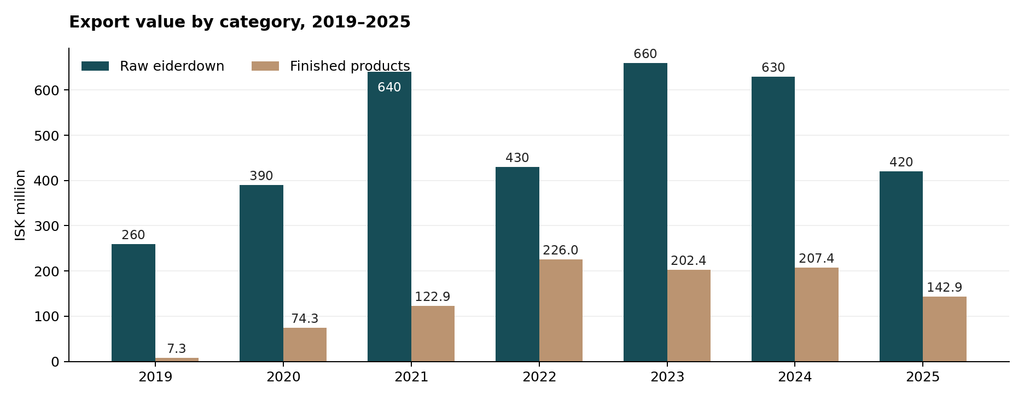
Recorded FOB export values for raw eiderdown and finished-product tariff categories, ISK million. These are different product categories and should not be added as measures of the same physical down.
The recorded value of finished-product exports increased from ISK 7.3 million in 2019 to ISK 142.9 million in 2025. It peaked at ISK 226.0 million in 2022. In 2025, finished-product export value was equivalent to approximately 34% of raw eiderdown export value.
Source: Statistics Iceland, exports by customs tariff code
Icelandic Down’s role in finished-product exports
The graph compares the national export value recorded under the selected finished-bedding tariff codes with Icelandic Down’s reported exports. It shows how important our contribution has become, while also showing why the figures must be compared with care.
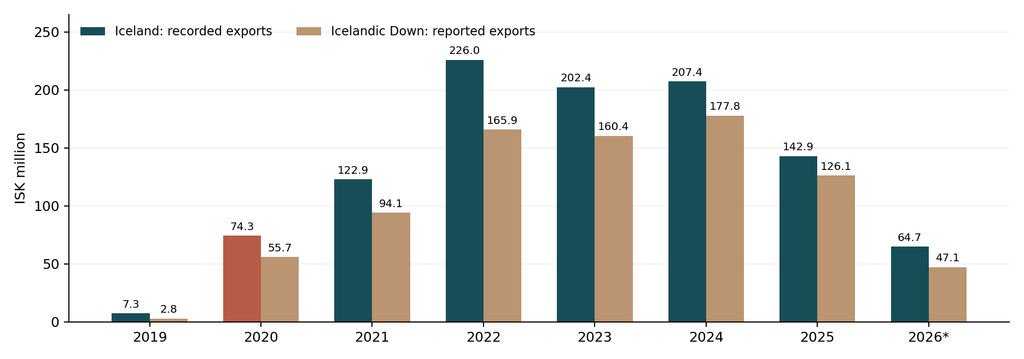
*2026 covers January–June only. ISK million. The two series may differ in timing and valuation.
In 2025, Icelandic Down reported ISK 126.1 million in exports, compared with ISK 142.9 million recorded nationally in the selected categories. That is a ratio of approximately 88%. We see this as an indication of our contribution, not a verified market share.
Source: Statistics Iceland, exports by customs tariff code
In 2020, the national export value of finished eiderdown products is estimated at ISK 74.3 million, compared with Icelandic Down’s reported exports of ISK 55.7 million. According to Statistics Iceland, some finished eiderdown products were incorrectly classified as raw eiderdown in the 2020 export statistics. The national export figure for 2020 is therefore an estimate, and the corresponding column is highlighted in a different color to distinguish it from the officially recorded figures for other years.
The selected customs categories show no recorded finished-product exports in 2017 or 2018, followed by exports in 2019. This is an important development in the data, although it does not prove that no finished Icelandic eiderdown products were exported before 2019.
Rare by nature
Eiderdown cannot be produced in unlimited quantities. The birds are wild, and the amount available each year depends on how many return, where they choose to nest and how successful the nesting season is. Weather and conditions at the nesting grounds can make a real difference. Unlike farmed down, Icelandic eiderdown comes from material the birds leave in their nests, and gathering it takes time and care. This natural limit is an important part of what makes eiderdown rare. Higher demand cannot simply create a larger harvest.
Source: Icelandic Eider Farmers Association
The people behind the numbers
Behind an annual harvest of only a few tonnes are eider farmers and their families, nesting grounds and generations of knowledge. Their experience tells us things the export figures cannot: when the birds return, how nesting progresses, and the quality of each harvest.
New markets and sleeping environments
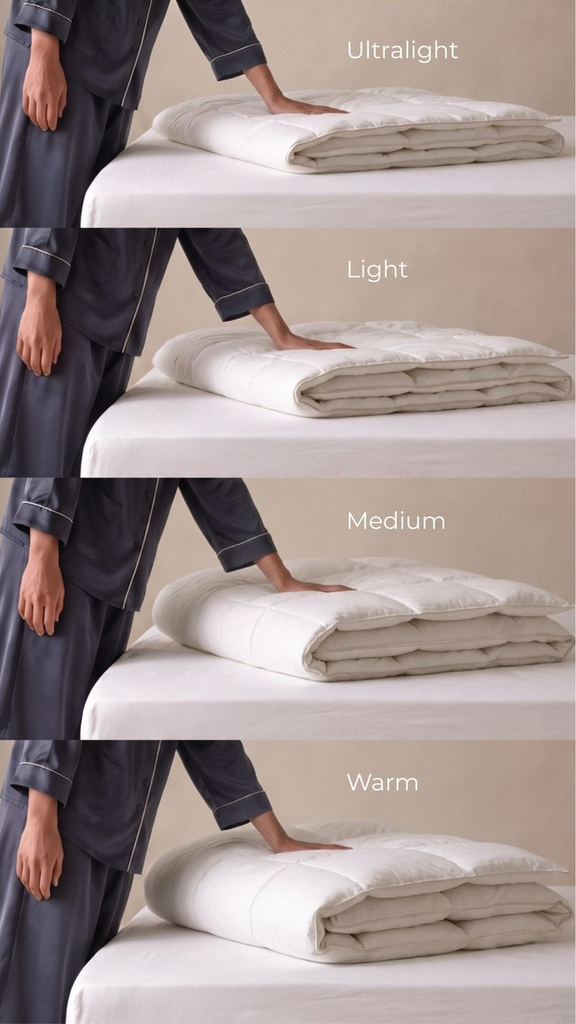
Our customer experience and market research suggest opportunities in warmer regions, particularly the Middle East and Southeast Asia. We have introduced an Ultralight duvet with a fill density of 80 g/m², intended for bedrooms around 22–24°C. This is based on our own market observation, not a conclusion drawn from national export statistics.
Authenticity and traceability
For a material this rare, knowing where it comes from matters. Iceland has a formal system for quality assessment of eiderdown. Under Act No. 52/2005 and Regulation No. 350/2011, cleaned eiderdown must be assessed and weighed by authorised inspectors before it is distributed domestically or exported, and a certificate must confirm that it has passed the assessment. The inspection considers cleanliness and the characteristics of the down. The regulation also allows inspectors to certify finished products filled exclusively with eiderdown, with the down assessed and weighed during filling. At Icelandic Down, we provide product-level information and certificates relating to the eiderdown used in our bedding. For us, traceability is about being able to explain where the material came from and how it became a finished product, not simply putting a country of origin on a label.
Sources: Act No. 52/2005 on quality assessment of eiderdown; Regulation No. 350/2011; Icelandic Down, product information
Looking ahead
Icelandic eiderdown will always be a limited natural resource, and I believe we should see that as both a responsibility and a strength. The future of this small industry depends on protecting nesting grounds, preserving the knowledge behind the harvest and maintaining the quality of the material. It also depends on making thoughtful choices about how we use the down that is available.
When we founded Icelandic Down in 2019, we wanted more of the work and value to remain here, in the country where the down originates. For centuries, Iceland exported eiderdown mainly as a raw material. Today, finished bedding made in Iceland is an increasingly visible part of the export story. There is still much to do, but I believe we have proved that this is a development worth building on.
Sources and methodology
Statistics Iceland: export tables by customs tariff code, historical series 2002–2025 — Raw eiderdown quantities, nominal export values and historical comparisons.
Statistics Iceland: raw eiderdown, 2017 – 2023 (UTA12811) – Chapter 1-40 tariff table.
Statistics Iceland: finished products, 2017-2023 (UTA12812) – Chapter 41-99 tariff table.
Statistics Iceland: raw eiderdown, 2024–2026 (UTA02801) — Chapter 1–40 tariff table; partial 2026 figures cover January–June.
Statistics Iceland: finished products, 2024–2026 (UTA02802) — Chapter 41–99 tariff table.
Customs tariff codes used: Raw eiderdown: 05051002 (historical), 05051012, 05051014 and 05051015. Finished eiderdown duvets: 94049010 (historical) and 94044010 (later classification). The report combines the applicable eight-digit Icelandic customs tariff codes across the years covered, to account for changes in classification. The corresponding six-digit HS headings are 0505.10 for raw down and 9404.90 / 9404.40 for finished bedding
Icelandic legislation — Act No. 52/2005 on quality assessment of eiderdown; Regulation No. 350/2011, including assessment and certification rules.Act No. 52/2005Regulation No. 350/2011
Icelandic Eider Farmers Association — Production estimate and general industry context.
Bændablaðið (2022) — Historical estimate of eider farmers.
RÚV (2025) — Nest yield and production context.
Act No. 52/2005 on quality assessment of eiderdown
Icelandic Down website — Company product context; company export, purchasing and market research figures are from internal records.
Reporting notes: All 2026 observations relate to January–June only. Figures and ratios are approximate where source tables are rounded. The 2020 export discrepancy remains under review.
Ragna Oskarsdottir, Icelandic Down

For similar stories
Join the newsletter.
Discover what makes our bedding truly special— bespoke craftsmanship, sustainable traditions, and our wonderful eiderdown.
Plus, 15% off your first order.